You get more customers when your business shows up as the answer.
Your Answer Content Engine researches what your buyers are asking right now, writes answers grounded in your business, and publishes them on autopilot. You approve. Content is done.
1,000+ answers published · Running in real businesses right now
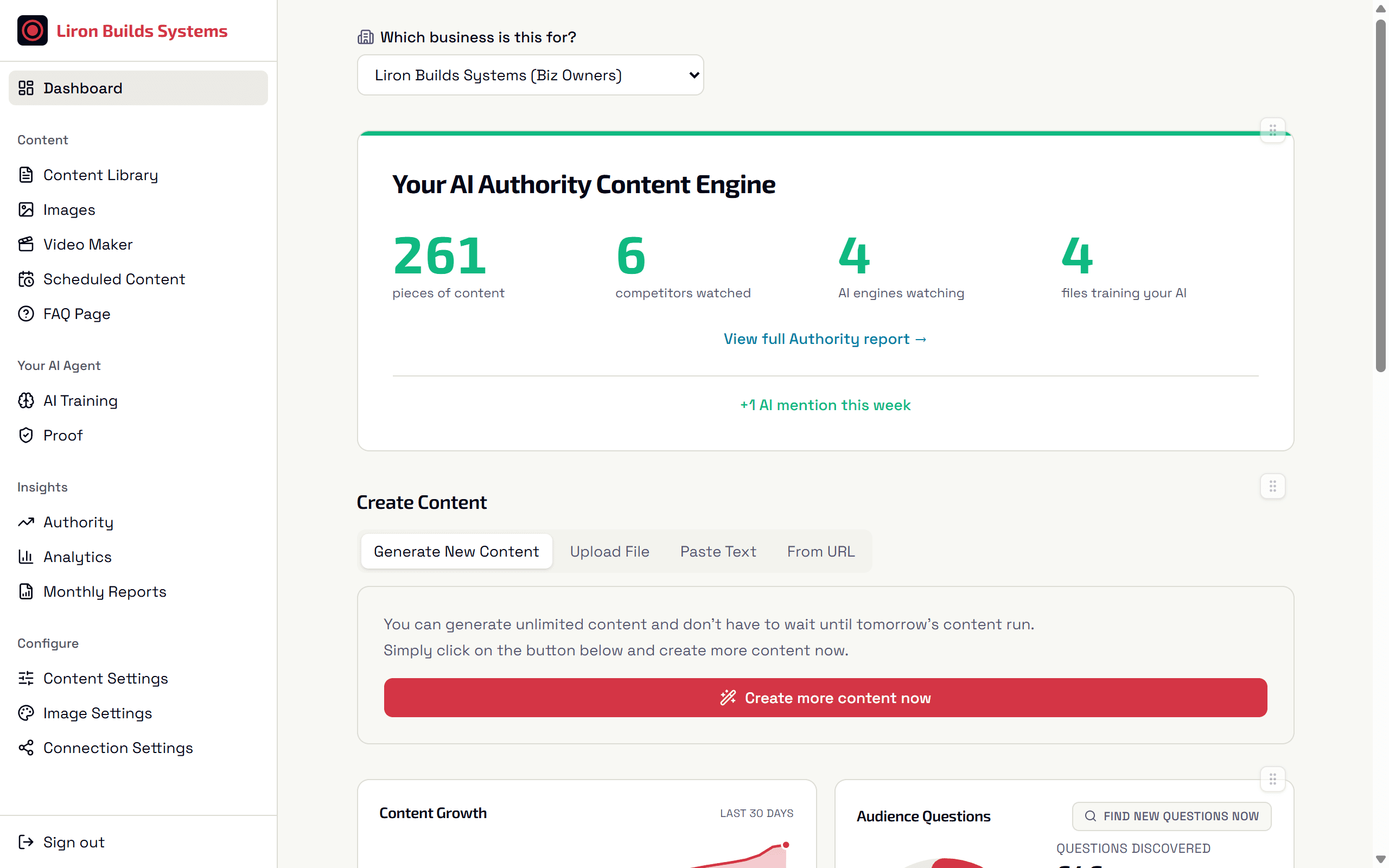
who is the best
Asked thousands of times a day, in every market. Including yours.
Your buyers ask Google, YouTube, and ChatGPT before they ever call. The business with the clearest answer wins the customer. That is the whole game.
Doing content yourself is not free.
- You research topics and hope they matter
- You write every post and article yourself
- You learn every platform's rules and algorithms
- You analyze what worked and start over again
- Hours every week pulled from running the business
- Researches buyer questions in real time
- Writes from your expertise and your voice
- Publishes automatically across your channels
- Learns which answers create conversations
- You approve. That is your whole job.
Your Answer Content Engine does the work. You just approve.
It researches in real time
Every day the engine finds the questions your buyers are asking right now across search, Reddit, YouTube, reviews, and AI tools like ChatGPT and Perplexity. No guessing. No content calendar brainstorms.
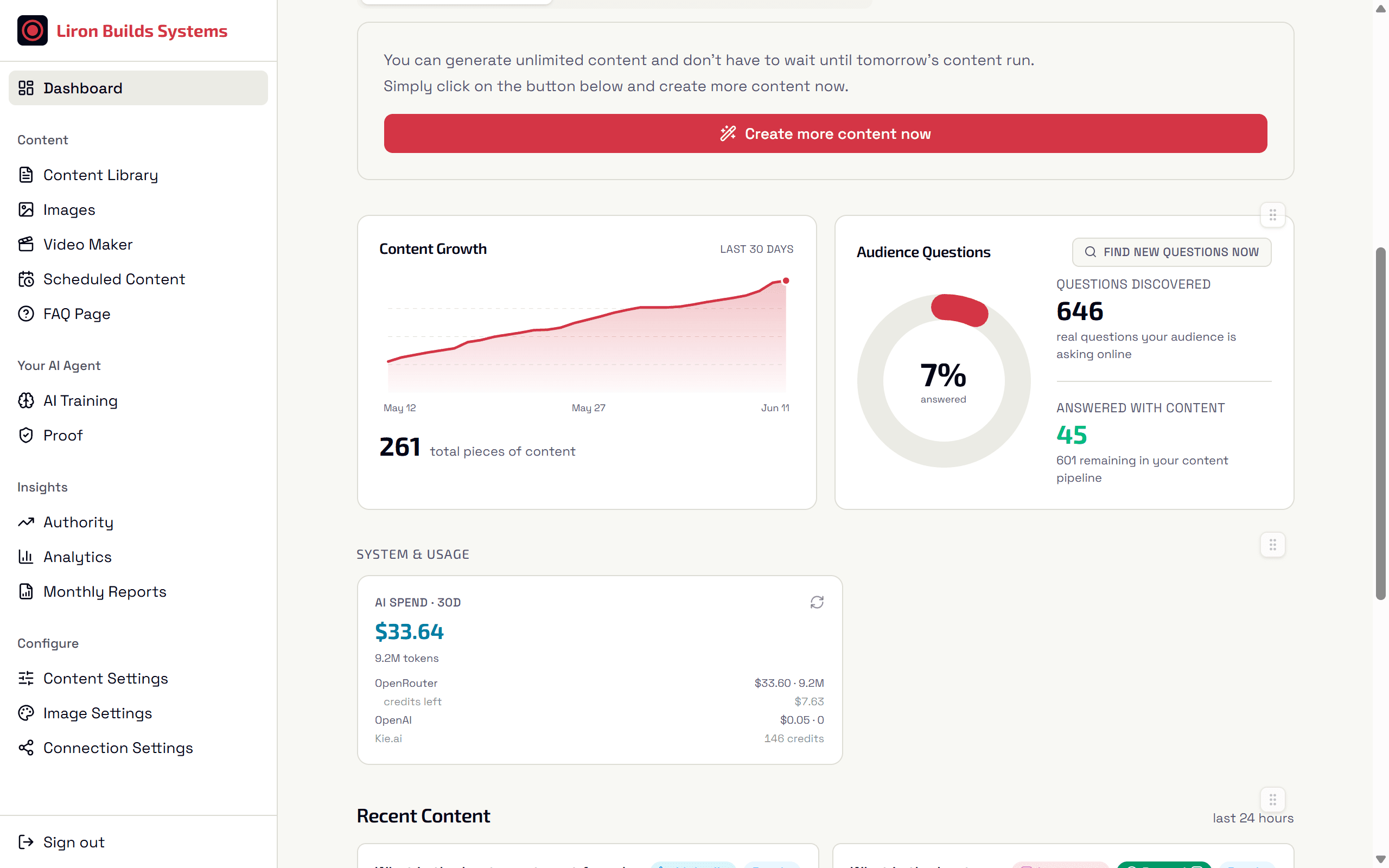
It writes from your business
Every answer is grounded in your AI OS: your expertise, your stories, your offers, your proof. Not generic AI filler that sounds like every other business in town.
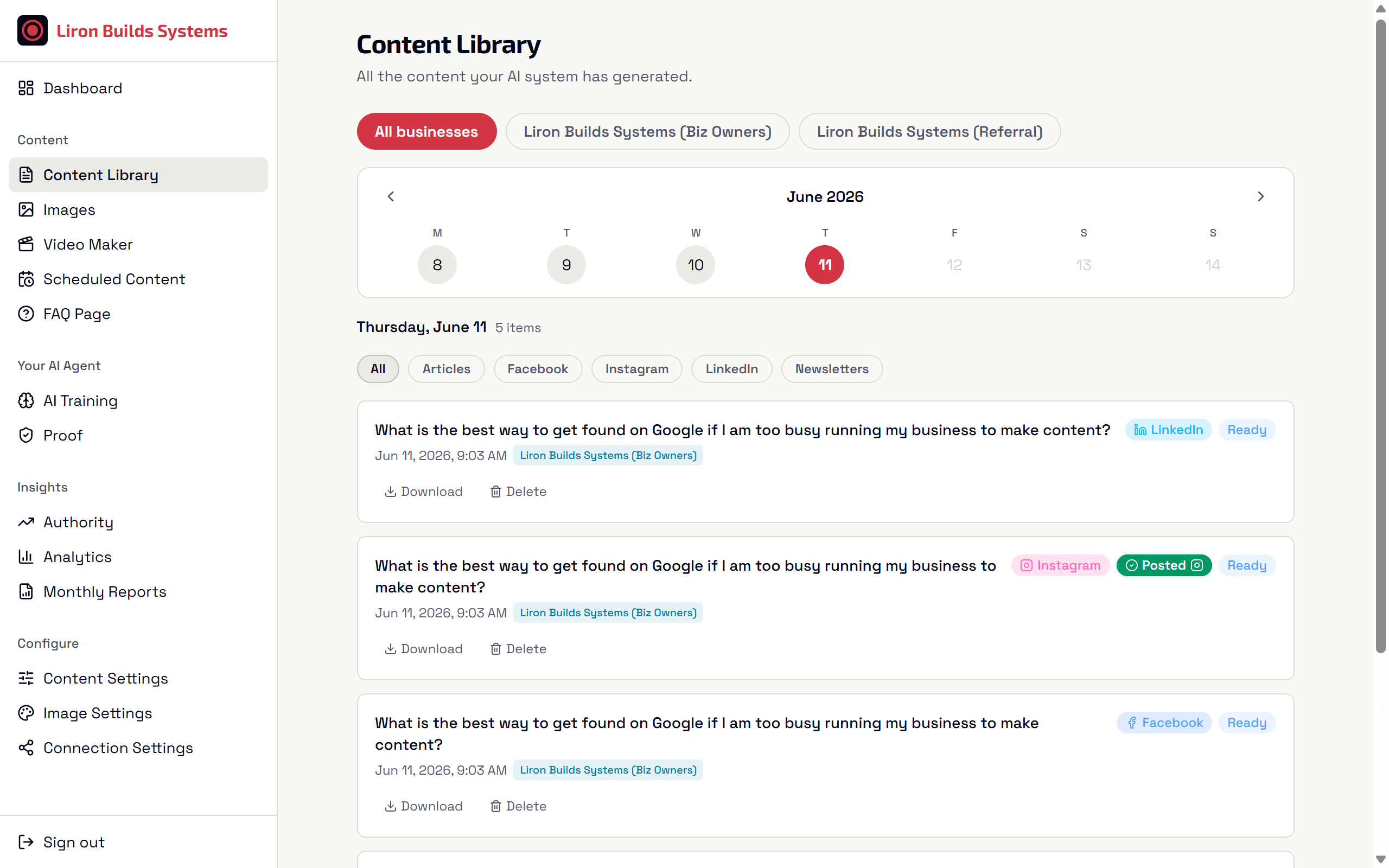
You approve. It publishes.
Your engine automatically created your articles, FAQs, social posts, newsletters. You approve and it posts everywhere. Content is done. You focus on running your business.
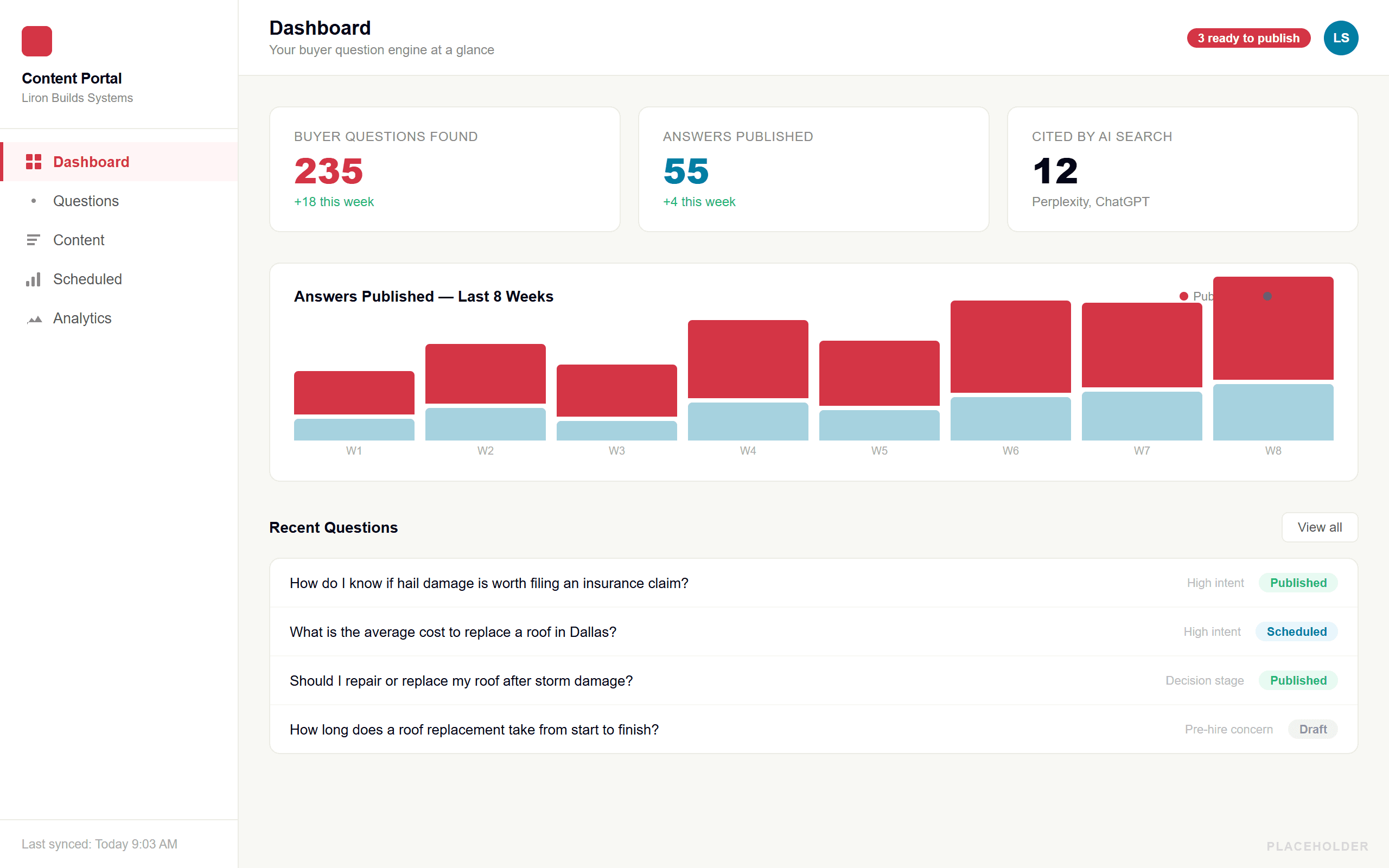
Publish everywhere
The system is running right now.
These numbers come from live client systems, including the one running this website.
 Your AI OS
Built 100% on your business.
Generic AI tools write for nobody. We build an AI operating system from your actual business: your niche, your expertise, your proof, your voice. Every answer your Answer Content Engine produces is grounded in what only you can say. That is why it sounds like you, not like every other business in your category.
The real cost of the alternatives.
| Your Answer Content Engine | Do it yourself | Agency | Hire someone | |
|---|---|---|---|---|
| Your time | Minutes to approve | 10+ hours a week | Meetings, emails, approvals | Managing a person |
| Who does the work | The engine | You | Their writers | Your hire |
| Grounded in your expertise | Yes. Built on your AI OS | Yes, but you do all of it | Generic. They have 30 other clients | Depends who you find |
| What you own | Everything. It is your asset | Your time, spent | Nothing when you cancel | The process walks out the door |
| Commitment | None. It keeps running | Forever | 3 to 6 month contracts | Salary, onboarding, notice periods |
You own the engine. All of it.
This is a business asset, not a SaaS subscription. Every other agency rents your content strategy back to you every month. Cancel and you start from zero. With your Answer Content Engine, you own the system, the question map, the workflows, and the content. It is built around your business. If you ever stop the retainer, the engine keeps running.
Your infrastructure, your accounts
Your expertise, your knowledge base
Your content, no SaaS to cancel
Stop the retainer. The engine keeps running.
Built for owner-operators, not everyone.
Built for you if
- ✓You run an established local or niche service business
- ✓Referrals are your engine, and you know they Google you first
- ✓You have tried content before and it did not stick
- ✓You want this handled, not another job on your plate
Not for you if
- –You are pre-revenue or just getting started
- –You have a marketing team or agency already doing this well
- –You want a cheap tool, not a working system
I did this in the most boring niche imaginable.

I built a YouTube channel to 1 million subscribers by answering what WiFi shoppers were really asking, consistently, with systems instead of luck. That is the same engine I build for you, pointed at your buyers. If it works for WiFi routers, it works for your business.
More about meCan't I just use ChatGPT?
"AI could never write our content."
Right. Generic AI content fails because the AI does not know your business. Your Answer Content Engine writes from a knowledge base of your positioning, your offers, your stance, and your proof. It is your expertise, structured, not someone else's content with your logo on it.
"We can do that ourselves with ChatGPT."
You cannot get this from one prompt. Topic selection is the work: if you answer questions buyers are not asking, you wasted the effort. The engine derives the intent behind each question, forces a first-hand angle from your actual expertise, structures every piece to get cited by AI search, and checks fact density before anything goes out. That is the whole point.
Your prospects are asking this. Your competitors are answering it. You are not.
That gap is what your Answer Content Engine closes.