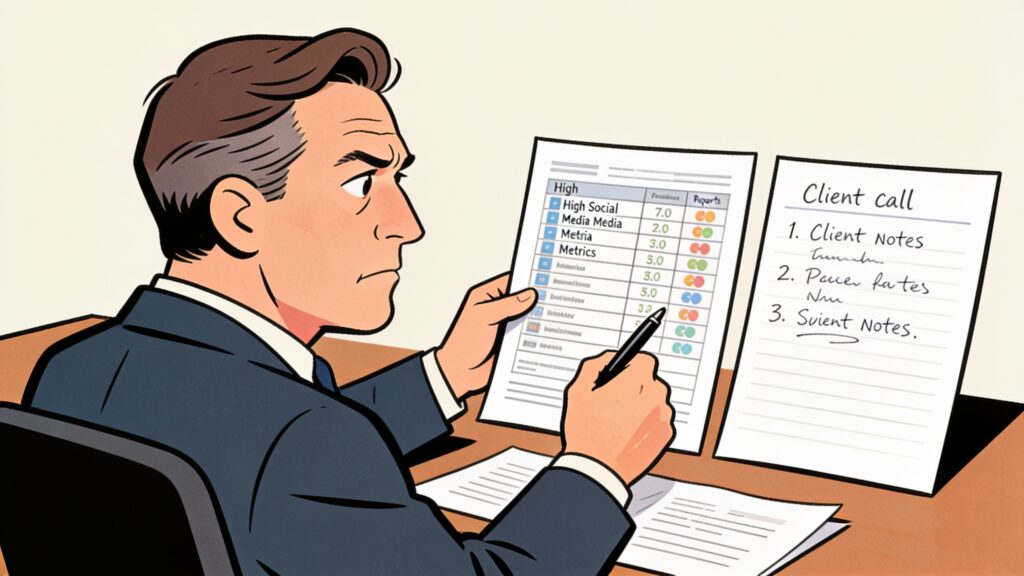
Most small business owners cannot measure content marketing ROI because they are tracking the wrong things. The right measure is not page views or follower counts. It is whether your content shows up when a buyer is researching before they hire, and whether the people who contact you afterward already understand what you do and why it costs what it costs. That shift in the quality of inbound conversations is the clearest signal content is working.
Here is why that framing matters and how to actually track it.
What Are You Even Trying to Measure?
Most people approach content ROI the way they would measure an ad. They want a number that says: I spent this, I got that. Content does not work that way, and any agency that tells you it does is setting you up to quit before you see results.
The honest frame is this: content either earns trust before the sales call, or it does not. That is the output worth measuring.
When a buyer types a question into Google or an AI search tool and your answer comes up, they arrive at your business already informed. They have read your thinking. They understand your process. They know roughly what to expect. That buyer is a different kind of conversation than someone who found you through a directory and wants to know your price before they know your name.
The metric that matters is qualified inbound conversations. Not raw lead volume. Not impressions. Whether the people who contact you are ready to talk about fit, not just price.
What Does Good Content Actually Look Like?
This is where most small business owners get it wrong. They produce content about themselves. Awards, team photos, service descriptions. That content does not answer anything a buyer is actively searching for, so it does not get found and it does not build trust.
Content that earns ROI answers the real questions a buyer is working through before they pick up the phone. Things like:
- What should I look for before hiring someone in this category?
- What are the risks of choosing the wrong provider?
- What questions should I ask on the first call?
- What does a good outcome look like in this type of project?
Those are not hypothetical. They are the questions your buyers are already asking. If your website does not answer them, a competitor's does.
The source material that powers the Answer Content Engine is built from exactly this kind of knowledge: the real objections that come up in every consultation, the tradeoffs you explain when someone asks why your process is different, the mistakes buyers make before they hire the right person. That specificity is what makes content discoverable. It is also what makes it credible when a buyer finds it.
How Do You Actually Track Whether It Is Working?
You do not need a complicated analytics dashboard to measure content ROI for a small service business. You need to track a few things honestly.
Are your answers showing up when buyers search?
This is the visibility check. Search the questions your buyers ask before they hire you. Not your business name. The actual questions. Do any of your pages, articles, or social posts appear? If the answer is no, your content is not in the research conversation at all.
Google's AI Mode now has over 1 billion monthly users, and those queries run about three times longer than traditional keyword searches. Buyers are not typing "plumber Dallas." They are typing "what should I ask a plumber before I hire them for a remodel." If your content is not shaped like an answer to a specific question, it is invisible to that search behavior.
Are the people who contact you already informed?
Ask everyone who reaches out how they found you and what they already know about your service. If they found you through your content and they are asking about process, timeline, and fit rather than just price, that is a signal. If they are still asking basic questions you have already answered publicly, either they did not find your content or your content is not clear enough.
Is the sales conversation shorter?
A buyer who has read your thinking before the call does not need the same 45-minute orientation. They already understand your positioning. The call is about fit, not education. If your sales calls are getting more efficient over time, and your close rate on those calls is improving, content is doing its job.
Are you getting fewer tire-kicker inquiries?
This one is underrated. Content that clearly explains your process, your ideal client, and what you do not do filters out buyers who were never a good fit. Fewer of those conversations is not a failure. It is a sign your content is qualifying for you.
What Should You Ignore?
Vanity metrics. Page views mean nothing if the people visiting are not buyers. Follower counts mean nothing if followers never hire. Likes and shares feel good but do not pay invoices.
NCSolutions has reported that creative quality drives nearly half of incremental sales. The implication for content is direct: the quality and relevance of what you publish matters far more than how many people see it. A hundred buyers who read a specific, useful answer to a real question they had are worth more than ten thousand people who scrolled past a generic post.
This is why consistent content posting alone does not move the needle. Volume without relevance is just noise. The signal is whether the content matches what buyers are actually searching for at the moment they are making a hiring decision.
Why Most Small Business Content Fails the ROI Test
The most common failure mode is not lack of effort. It is lack of specificity. Generic content gives AI search systems and human buyers no reason to choose one business over another. If your article about "how to choose a service provider" could have been written by anyone in your industry, it probably will not rank, will not be cited, and will not earn trust.
The content that performs is the content only you can write because you have lived it. The real customer questions you hear on sales calls. The real tradeoffs you explain when a client asks why your process is different. The real mistakes you see buyers make before they hire the right person. That specificity is what makes content findable. It is also what makes it credible when a buyer finds it.
This is the same reason businesses that compete online without marketing budget can still win. Budget matters less than specificity. A well-answered question from a genuine expert beats a polished generic article every time.
The Answer Content Engine that Liron Builds Systems deploys is built around this principle. It extracts the expertise the business owner already has, structures it as clear answers to real buyer questions, and publishes it on a schedule across the channels where buyers are researching. The measurement is built into the framework: are the right questions being answered, are those answers showing up, and are the conversations that follow more qualified.
That is how you measure content ROI. Not by counting clicks. By counting better conversations.
Checklist
- Search the top five questions your buyers ask before they hire you and check whether any of your content appears in the results
- After every inbound inquiry, ask how they found you and what they already knew about your service before contacting you
- Track whether your sales calls are getting shorter and whether close rates on content-sourced inquiries differ from referral or directory inquiries
- Review your last ten pieces of content and identify how many of them directly answer a specific buyer question versus describing your services
- For expert-led local service businesses, confirm your content is written with the specificity of your actual experience, not generic industry advice any competitor could publish
- Set a simple baseline now: note how many of your inbound conversations this month are price-first versus process-first, then recheck in 90 days
FAQ
How do I know if my content marketing is actually bringing in clients?
The clearest signal is a change in the quality of your inbound conversations. When buyers contact you already knowing your process, your pricing range, and why you are different from competitors, that knowledge came from somewhere. If it came from your content, content is working. Track where inquiries originate and what buyers already know when they reach out.
What is a realistic timeline to see ROI from content marketing for a small business?
Most small service businesses start seeing a measurable shift in inbound conversation quality within three to six months of publishing specific, question-based content consistently. The first month or two tends to be invisible. By month four or five, if the content is answering real buyer questions, you will notice fewer price-only inquiries and more calls from buyers who are already pre-sold on your approach.
Is tracking page views and social media followers a good way to measure content ROI?
No. Page views and follower counts are vanity metrics for a service business. A buyer who reads one specific article that answers exactly the question they had is worth more than a thousand people who scrolled past a generic post. The metrics that matter are qualified inbound conversations, sales call length, and close rate on content-sourced inquiries.
What kind of content actually brings in buyers for a local or niche service business?
Content that answers the specific questions buyers are researching before they hire. Not service descriptions, not awards announcements. Things like what to look for when hiring in your category, what the risks of a bad hire look like, what a good outcome involves, and what questions to ask on the first call. That is the content buyers are searching for, and it is the content that earns trust before the sales call.
How do I know if my content is showing up in AI search results?
Search your own buyer questions in Google, ChatGPT, or Perplexity and see if your content appears. Google's AI Mode now processes queries that run about three times longer than traditional keyword searches, which means buyers are asking full questions, not just typing short phrases. If your content is not shaped like a direct answer to a specific question, it is unlikely to appear in those results.
What is the difference between content ROI and content that just looks good?
Content that looks good gets likes and shares. Content with real ROI gets found by buyers at the moment they are deciding who to hire, answers their actual question, and sends them to your business already trusting your expertise. The difference shows up in your sales calls: one type produces price shoppers, the other produces buyers who already understand your value.
Do I need a lot of content for it to work, or does quality beat quantity?
Specificity beats volume every time. One article that directly answers a real buyer question with genuine expertise will outperform ten generic posts. That said, publishing one good article and stopping does not build authority. A steady cadence of specific, question-based content is what creates a body of work that earns sustained visibility and trust.
Written by Liron Segev, AI Systems Consultant