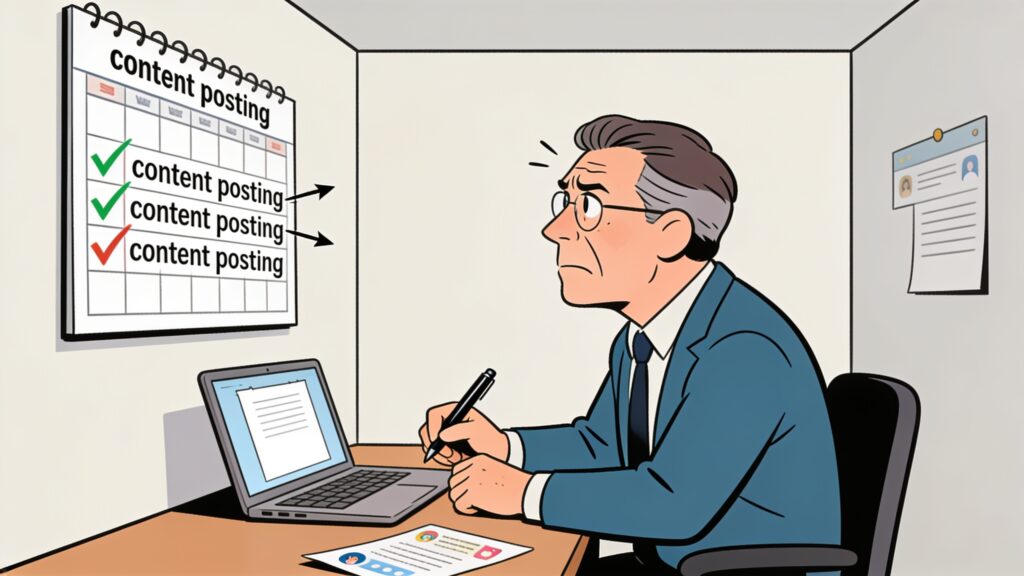
Most service business owners stop content marketing for the same reason: the system depends entirely on them. You start strong, post consistently for a few weeks, then a busy client month hits and the whole thing collapses. That's not a willpower problem. That's a design problem. Any content approach that requires you to generate ideas, write posts, and manually publish everything will eventually fail because your delivery work will always win the time fight.
Why Does Every Content Push End the Same Way?
You've probably done this more than once. You decide this is the month you get serious about content. You write a few posts, maybe start a blog. The first two weeks feel productive. Then a client needs something urgent. Then it's the end of the month and you've posted nothing. Then the guilt sets in and the whole thing feels harder to restart than it did to start.
This isn't a character flaw. It's a predictable outcome of how the work is structured.
Manual content creation requires you to do three separate jobs every single time: figure out what to write about, write it, and then publish it across whatever channels you're using. Each of those steps takes time you don't have. And unlike client work, there's no deadline forcing you to do it. So it doesn't get done.
The pattern is so consistent that it's worth naming it clearly. The content-starter-quitter cycle isn't about motivation. It's about what the work actually demands from you versus what you actually have available.
What's Actually Breaking the Cycle?
When most business owners try to fix this, they try to fix the wrong thing. They set calendar reminders. They batch content on Sunday afternoons. They hire a social media manager who posts generic tips that sound nothing like them. None of it sticks because none of it removes the core dependency: the system still needs you to feed it.
A calendar reminder doesn't generate ideas. A virtual assistant can't extract your expertise without you spending hours explaining it. A batch session works until the quarter gets busy, then it's gone.
The real problem, as we've seen across every type of expert-led service business, is that content production has become an operating bottleneck. And you're trying to solve an infrastructure problem with scheduling tricks.
Think about it this way: you wouldn't solve a billing bottleneck by reminding yourself to invoice more often. You'd build a system that invoices automatically. Content works the same way. The question isn't how to motivate yourself to post. The question is how to remove yourself from the production chain entirely.
This is exactly why content creation without time investment keeps coming up as the real ask from busy operators. The goal isn't to become a better content creator. The goal is to stop needing to be one.
What Does a System That Actually Runs Look Like?
A proper Answer Content Engine researches what your buyers are actually asking before they hire you, generates content from those live questions, and posts directly to WordPress, a newsletter, and social media without you copy-pasting between platforms. That's not a description of a tool. That's a description of working infrastructure.
Here's what that means in practice. The content research happens automatically. The generation happens automatically. The publishing happens automatically. The system reads its own analytics and adjusts what it produces based on what's landing. You don't feed it ideas. You don't approve every post. You don't write anything.
Building that infrastructure takes real work upfront. A custom Answer Content Engine with proper workflow architecture takes about a week of focused build time. But once it's built, it runs. There's no ramp-up period where you're feeding it brand guidelines for six months before it produces anything useful.
The output is real. An established residential real estate business running this kind of engine produced 240 pieces of ready-to-publish content in 30 days. The owner wrote none of it. That's not a one-month sprint. That's what the system produces every month, on a schedule, without the owner being in the loop.
We run the same engine on our own brand at Liron Builds Systems. In the last 30 days it produced 336 pieces of ready content across articles, social posts, and a newsletter. The same problem every client has, which is that the business owner is too busy with delivery to write daily content, applies to us too. The difference is we built the infrastructure to solve it instead of relying on discipline.
Why Does This Work When Manual Posting Doesn't?
The reason the cycle breaks is structural, not motivational.
When content production depends on your time and energy, it competes with every other demand on your business. Client work, operations, sales calls, and everything else will always outrank content creation because content has no immediate consequence for skipping it. The business doesn't fall apart today if you don't post. So you don't post.
When content production runs on a system that doesn't need you, it doesn't compete with anything. It runs whether you're in back-to-back client calls or on vacation. The publishing schedule doesn't care what's happening in your business this week.
There's also the question of what gets published. Generic tips and motivational posts don't build authority because they're interchangeable with everything else in your market. The Answer Content Engine maps the Buyer Question Map for your specific market, which means the content it produces answers the real questions your buyers are searching before they hire. That's what builds trust before the sales call. Not volume for volume's sake. Relevant, specific answers that only someone with your expertise could give.
If you've been wondering why getting found on Google without writing content is even possible, this is the mechanism. The content exists and keeps publishing. You just aren't the one producing it.
So Is This Actually Sustainable?
The honest answer is that any content approach requiring your direct involvement will eventually break. Not because you're undisciplined. Because you have a business to run and content will always lose the priority fight.
A system that runs in your own infrastructure, on a schedule, without needing you to generate ideas or write anything, doesn't have that problem. It runs the same way on a slow week as it does on a chaotic one.
The goal isn't to become a consistent content creator. The goal is to build something that creates consistently on your behalf, gets sharper over time from real analytics, and earns you authority in your market without requiring you to show up every time a post needs to go out.
The Answer Content Engine is what that looks like when it's built properly and deployed in infrastructure you own outright.
Checklist
- Before starting another content push, ask whether the approach requires your time every single time it runs. If yes, it will fail when you get busy.
- Map the actual bottleneck: is it idea generation, writing, or publishing? Most service business owners are stuck at all three simultaneously.
- If you've hired a social media manager and still feel like the content doesn't sound like you, the problem is that your expertise was never properly extracted.
- Look at your last three content attempts and identify the specific week they stopped. That week usually coincides with a client delivery crunch, not a motivation failure.
- For expert-led local or niche service businesses, the standard for content isn't more posts. It's posts that answer the real questions your buyers search before they hire you.
- Consider whether you need a better content habit or a different infrastructure entirely.
FAQ
Why do I keep stopping content marketing even when I know it's important?
The most common reason is that manual content creation depends on your time and energy every single time it runs. When a busy client period hits, content creation loses the priority fight because skipping it has no immediate consequence. The issue isn't motivation. It's that the approach is designed to fail under normal business pressure.
Is batch-creating content on weekends a real solution to staying consistent?
It works until it doesn't. Batch sessions help short-term but they still require you to generate ideas, write, and schedule everything yourself. The moment a busy quarter hits or a big client project lands, the batch session gets skipped. Any approach that still depends on your direct involvement will eventually break.
What does a content system that runs without me actually look like?
A proper Answer Content Engine researches the real questions your buyers are asking before they hire, generates content from those live questions, and publishes automatically to WordPress, newsletter, and social channels. There's no copy-pasting between platforms and no idea generation required from you. Once it's built, it runs on a schedule regardless of what's happening in your business.
How much content can a system like this actually produce?
An established residential real estate client's engine produced 240 pieces of ready-to-publish content in 30 days without the owner writing anything. The engine running on our own brand at Liron Builds Systems produced 336 pieces in the last 30 days across articles, social posts, and a newsletter.
Does automated content actually sound like me, or is it generic?
Generic content comes from systems that don't extract your specific expertise. An Answer Content Engine built on the Buyer Question Engine framework maps the real questions in your specific market and generates answers grounded in your expertise. The output isn't interchangeable tips. It's specific answers that reflect what only someone with your background would know.
How long does it take to build something like this?
The infrastructure build takes roughly a week of focused work. That covers the custom workflow architecture, the research layer, the generation layer, and the multi-channel publishing connections. Once it's built, it runs without a ramp-up period. There's no six-month setup phase before it produces anything useful.
Is this only for businesses with big marketing budgets?
The Answer Content Engine is built for established local and niche service businesses, typically owner-operators with small teams who are currently dependent on referrals and want to build authority without hiring a full agency. The system is deployed in the client's own infrastructure and owned outright, so there's no ongoing agency retainer.
Written by Liron Segev, AI Systems Consultant