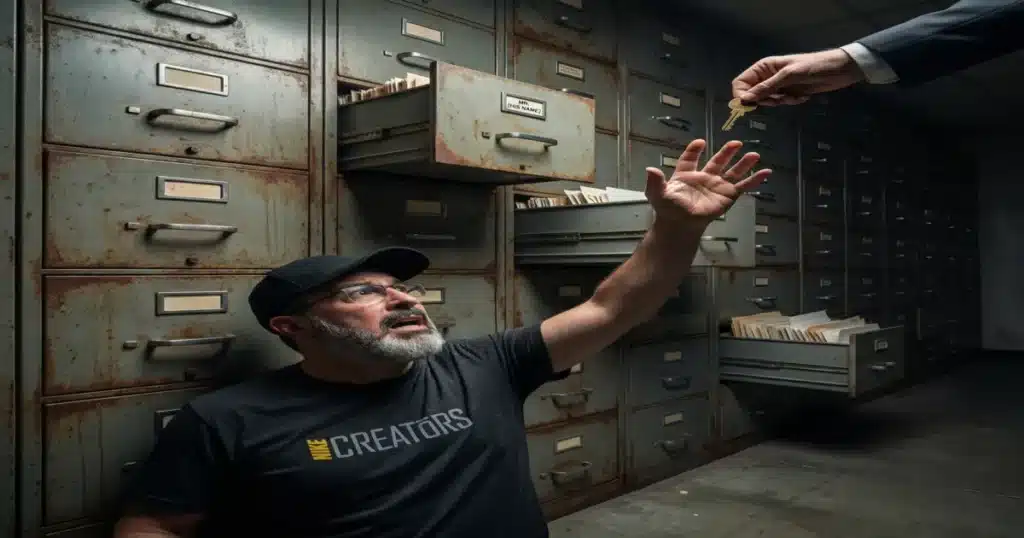
You’ve been burned before. You signed up for content services, paid monthly fees for six months or a year, and when you finally canceled because the content wasn’t working, you walked away with nothing. No assets. No systems. No way to keep running what you’d paid to build. Just a bunch of generic posts that never sounded like you anyway, sitting in some agency’s dashboard you can’t access anymore.
The Real Problem: You’re Renting Content, Not Building Assets
Most business owners think they’re buying content when they hire an agency. They’re not. They’re renting the illusion of content creation while the agency keeps everything that matters.
The content lives in the agency’s social media management platform. The brand voice guidelines exist in their internal documents. The content calendar sits in their project management system. The audience insights and engagement data belong to them. Even the content itself is often created using the agency’s prompts, workflows, and AI subscriptions.
When you stop paying, you don’t just lose future content creation. You lose access to everything you thought you owned. It’s like paying rent on a house for two years, then being surprised when the landlord keeps the house after you move out.
This isn’t an accident. It’s the business model. Agencies profit from dependency, not from building systems you can run without them.
The Shift: Own Your Content Infrastructure, Don’t Rent It
Here’s what changes everything: treating content like business infrastructure instead of a service you buy monthly.
You wouldn’t rent your accounting system from someone who could cut off your access to your financial data. You wouldn’t lease your CRM from a vendor who owns your customer relationships. But somehow, business owners accept this exact arrangement for content.
Your expertise is trapped in calls and docs. A Content Engine frees it. But only if you own the system that captures and scales that expertise. Capture over creation. Explain once, AI scales forever.
The difference between renting and owning isn’t just philosophical. It’s practical. When you own your content system, you control when it runs, how it sounds, and whether it keeps working if you decide to change providers.
How Content Ownership Actually Works
Real content ownership means you control three things: the capture mechanism, the processing workflows, and the output distribution.
The capture mechanism is how your expertise gets documented. Instead of hoping an agency writer interprets your industry correctly, you record your actual client calls, strategy sessions, and explanations. That’s your raw material. Your voice. Your insights. Your specific way of explaining complex concepts that clients understand.
The processing workflows transform that captured expertise into content. These are the prompts, the formatting rules, and the AI instructions that turn a 30-minute call recording into five different pieces of content. When you own these workflows, you can modify them, improve them, or completely change them without asking permission or paying extra fees.
The output distribution connects your content to your channels. But instead of posting through an agency’s social media tool that you can’t access, you control where your content goes and how it gets published.
When you own all three pieces, stopping payment to any provider doesn’t kill your content system. It just means you might need to plug in a different AI service or find a new distribution tool. The core system keeps running because you built it, not them.
Why Most People Get This Wrong
The agency model feels safer because it promises to handle everything. You write a check, they deliver content. No learning curve. No technical setup. No ongoing management.
But that convenience is expensive in ways that don’t show up in the monthly invoice. You’re not just paying for content creation. You’re paying to remain dependent. Every month you stay subscribed is another month you don’t own the system that creates your content.
Most business owners realize this too late. They cancel the agency after six months of mediocre results and discover they have nothing to show for the investment. No processes they can replicate. No understanding of what worked or didn’t work. No way to continue creating content without starting over completely.
The DIY alternative seems worse because most content automation tools are built for agencies, not business owners. They’re complex, require technical knowledge, and still leave you dependent on the platform provider.
The answer to “what happens to my content when I stop paying my agency” is simple: you lose everything that matters. Unless you own the system that creates it. Then you just change providers while your content engine keeps running. Build once, run forever.