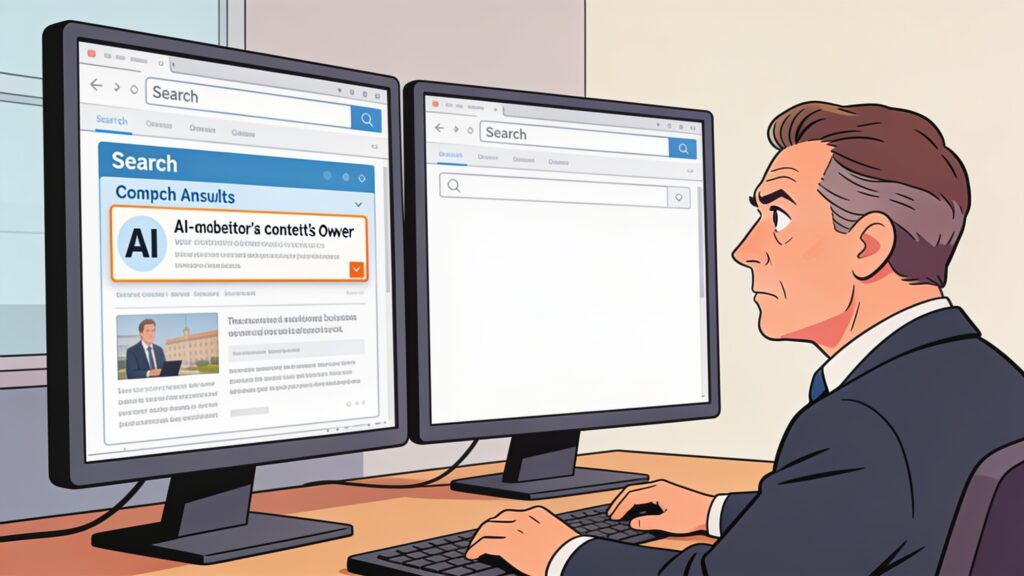
Google's AI search redesign has created a hard split between businesses that get found and businesses that disappear from buyer research entirely. If your content does not directly answer the specific questions buyers ask before they hire someone like you, the AI has nothing to pull you into the conversation. This is not a ranking problem. It is a content problem, and the gap between visible and invisible is widening every month.
Here is what changed, what it means for expert-led B2B service businesses, and what you can actually do about it.
What Did Google Actually Change, and Why Does It Matter?
Google's AI Mode is being described internally as the biggest search redesign in 25 years. That is not marketing language. It reflects a genuine shift in how the platform works.
Traditional search returned a list of links. A buyer typed a short keyword, got ten blue links, and clicked through to your site. Your visibility depended on ranking high enough to get that click.
AI Mode works differently. A buyer types a long, messy, task-style question — something like "I need to find a B2B consultant who can help me fix our sales process before we go into a new market" — and Google assembles an answer directly inside the search interface. It pulls from sources it trusts, synthesizes a response, and often does not send the buyer to any individual site at all.
This shift is significant. AI Mode has already surpassed 1 billion monthly users. The queries being typed into AI Mode are three times longer than traditional search queries. Buyers are not typing keywords anymore. They are describing their situation and asking for help.
If your business is not publishing content that matches those longer, situation-based questions, the AI skips you. Not because it dislikes you. Because it has nothing from you to work with.
Why Is Generic SEO Content Suddenly Invisible?
The old SEO playbook was built for keyword matching. Write a page with the right phrase density, get some backlinks, rank on page one. That approach still has a role, but it is no longer the primary visibility mechanism for AI search.
AI search is evaluating whether your content is genuinely useful to someone in a specific situation. It is looking for trusted, structured, widely-cited material it can fetch, parse, and confidently include in a synthesized answer. Generic service pages that say "we provide strategic consulting solutions" give the AI nothing to work with. There is no specific claim, no real answer, no signal that this business actually knows what it is talking about.
This is where expert-led B2B service businesses face a specific challenge. Most of them have deep expertise, but that expertise lives in their heads, in client calls, and in proposals that never see the public internet. Their websites describe what they do in vague, category-level language that sounds like every other firm in the space.
AI search visibility is now determined by whether you have published specific, useful answers to the real questions buyers are researching. If you have not, you are absent from the most important part of the buyer's decision process.
What Does the Discoverable-vs-Invisible Divide Actually Look Like?
Two B2B consultants with similar expertise and similar client results. One publishes detailed answers to the questions buyers ask during the research phase: how to evaluate a firm, what the process looks like, what outcomes are realistic, what to watch out for. The other has a clean website with a services page and a contact form.
The AI knows about the first one. It can pull from their content, summarize their position, and surface them as a credible answer when a buyer asks a relevant question. The second one is invisible in that same moment, not because they are less capable, but because the AI has nothing from them to cite.
This is the discoverable-vs-invisible divide. It is not about brand size, ad spend, or how long you have been in business. It is about whether the AI has enough material from you to include you in the answer it is building.
NCSolutions research cited in Google's own 2026 marketing materials puts creative content quality as driving 49% of incremental sales. That is not a content marketing talking point. That is the AI's parent company saying that what you publish materially affects whether buyers choose you. Businesses that get found on Google without writing content on their own are increasingly rare — the ones who do have a system doing the work.
What Kind of Content Actually Works in AI Search?
The content that gets pulled into AI-generated answers shares a few characteristics. It is specific. It is structured. It answers a real question a buyer would actually ask. And it comes from a business that has published enough of it to signal consistent expertise.
What does not work is vague. A page that says "we help businesses grow" answers nothing. An article that explains what a B2B service firm actually does in the first 90 days of an engagement, what questions to ask before signing, or how to tell whether a firm's process fits your situation — that answers something real. The AI can use it.
Google has been explicit about this framing: the winning business in AI search is the one whose content is helpful enough to become the answer. Not the one with the most backlinks, not the one with the biggest ad budget. The one with the most useful, specific, trustworthy content on the questions buyers are actively asking.
For expert-led B2B service businesses, this is actually good news, with a catch. The expertise is there. The specific opinions, the process knowledge, the real-world experience that would make genuinely useful content — most of these business owners have it in abundance. The problem is that producing content consistently, at the volume AI search now rewards, is a real operational bottleneck. Google has named this directly: constant demand for fresh, high-quality content is one of the primary constraints for businesses trying to maintain AI search visibility.
The businesses solving this are not hiring bigger content teams or posting more randomly. They are building a repeatable system that extracts expertise and turns it into structured, useful answers on a schedule. That is what the Answer Content Engine at Liron Builds Systems is designed to do — take what the business owner already knows and turn it into the kind of content AI search can actually use.
Summary: The Search Landscape Changed, and the Window Is Still Open
The shift to AI-generated search answers is not coming. It is here, at scale, with over a billion users already using AI Mode monthly. The businesses that are visible in that environment are the ones that have published specific, useful, answer-shaped content. The ones that have not are invisible at the exact moment a buyer is deciding.
For expert-led B2B service businesses, the expertise to create that content already exists. The gap is not knowledge. It is the operational capacity to produce it consistently enough that AI search has enough material to trust you.
That window is still open. The businesses that move first build a visibility position that becomes harder to displace over time. The ones that wait until the system feels more settled will be playing catch-up against competitors who are already the trusted answer.
Checklist
- Audit your current website and published content: does any of it directly answer the specific questions a buyer would ask before hiring a firm like yours?
- Identify the five to ten questions buyers most commonly ask during your sales conversations — those are your highest-value content targets for AI search visibility.
- Check whether your service pages describe what you do or actually explain how you work, what outcomes are realistic, and what makes your approach different.
- If you are an expert-led B2B service business, map your content against the buyer's research phase, not just the decision phase — AI search happens earlier than most owners realize.
- Decide whether you have the operational capacity to produce useful, specific content consistently — if not, that is the bottleneck to solve first, before worrying about distribution.
FAQ
Why does AI search hurt businesses that have good websites but thin content?
A well-designed website that describes services in general terms gives AI search engines very little to work with. AI Mode is looking for specific, useful answers it can synthesize into a response for a buyer's question. If your pages do not contain those answers, the AI skips your site regardless of how professional it looks. Design does not compensate for absent content.
How long do AI Mode queries actually run compared to regular searches?
According to Google's own data, AI Mode queries are three times longer than traditional search queries. Instead of typing two or three keywords, buyers are describing their situation in full sentences — often including context about their industry, their problem, and what kind of solution they are looking for. Content that matches that level of specificity is what gets surfaced.
Does this affect B2B service businesses differently than product companies?
Yes. B2B service businesses sell expertise, process, and trust — things that are difficult to evaluate from a service page alone. Buyers research heavily before reaching out. AI search is used heavily during that research phase. If a B2B service firm has not published content that addresses that research phase specifically, they are absent from the conversation when the buyer is forming their shortlist.
What makes content trustworthy enough for AI search to cite it?
AI search favors content that is specific, consistent, and structured around real questions. A business that has published many specific, useful answers on related topics signals consistent expertise. A business with one vague overview page signals nothing. The pattern of publishing matters as much as any single piece.
Is this just an SEO problem, or does it affect other channels too?
It affects the entire top of the buyer's research journey. AI search is increasingly where buyers form their initial understanding of a problem and who might solve it. If a business is invisible there, it misses the research phase entirely and only gets considered if a referral or direct introduction brings them in. That is a significant constraint on growth for any expert-led firm relying on being findable.
How does a business start fixing its AI search visibility without overhauling everything?
Start with the questions buyers actually ask during sales conversations and proposals. Turn those into specific, useful articles or posts. Publish them consistently, not perfectly. The goal is to give AI search engines enough material to understand what you do, who you serve, and why your approach is different. Volume of specific, relevant answers matters more than the polish of any single piece.
Does Google's AI Mode send any traffic to websites, or does it keep users on Google?
AI Mode often answers questions directly within the search interface, which reduces the number of clicks sent to individual sites. However, businesses that are cited as sources in AI-generated answers still receive visibility, credibility, and some referral traffic. More importantly, being cited positions the business as the trusted answer — which affects buyer perception even when they do not click through immediately.
Written by Liron Segev, AI Systems Consultant