Paying for ads every month is not the only way to stay visible online. The best long-term approach for a small business is to build owned content infrastructure — answers to the real questions your buyers search before they hire — that keeps working whether you're running campaigns or not. Paid ads stop the moment the billing stops. Content that answers real buyer questions keeps getting found. The difference is not effort. It's what you're building toward.
Why Do Paid Ads Feel Like a Treadmill?
Because they are one.
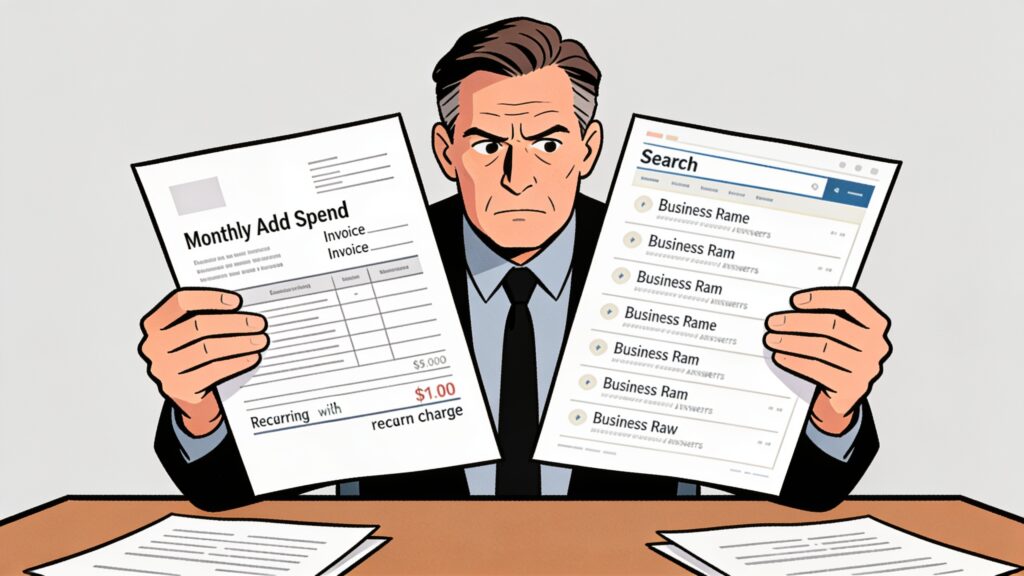
The mechanics are simple and brutal: you pay, you appear. You stop paying, you disappear. There's no residual. No carry-over. No asset sitting on your balance sheet after the campaign ends. Every dollar you spent last month bought visibility for last month.
That's not a knock on paid ads as a tactic. For specific campaigns, product launches, or short windows where you need fast traffic, they can make sense. The problem is when a small business treats ad spend as its primary visibility strategy. You're not building anything. You're renting attention, and the landlord raises the rates every year.
The business owners who feel this most acutely are the ones who've been at it for a while. They've spent real money. They've seen the traffic spike when the campaign runs and crater when it stops. They know the math doesn't improve over time — it gets worse as competition drives up cost-per-click in most local service categories.
The question isn't whether paid ads work. The question is whether you want to still be paying for the same visibility five years from now.
What Does "Owned" Visibility Actually Mean?
It means your content lives on infrastructure you control, answers questions your buyers are actively searching, and doesn't expire when a billing cycle ends.
That sounds abstract, so here's what it looks like in practice. A buyer in your market has a problem. They open Google or an AI assistant and type a specific question — not a two-word keyword, but a real question. Something like "how long does this process take" or "what should I look for when hiring someone for this" or "is this worth the cost." They're doing research before they make a shortlist.
If you have a clear, useful answer published and findable, you're in that research phase. If you don't, you're not. And it doesn't matter how good you are at the actual work.
The shift in how people search makes this more pressing than it used to be. AI Mode on Google has surpassed 1 billion monthly users, and those queries are running about three times longer than traditional search queries. Buyers aren't typing "plumber Dallas." They're typing "what questions should I ask before hiring a plumber for a full bathroom remodel." That's a fundamentally different search behavior, and it rewards businesses that have published specific, useful answers — not businesses that have the biggest ad budget.
We tested 17 businesses against their own buyer questions — the kind of questions their buyers actually type into AI assistants before making a hiring decision. On average, a business showed up as the recommended answer for fewer than one of ten questions. Thirteen of the seventeen appeared in zero AI answers for any of them. That's not a paid-vs-organic debate. That's a visibility gap that ad spend doesn't fix.
What Kind of Content Actually Builds This?
Not generic posts. Not "tips" content. Not the stuff that reads the same as every other business in your category.
The content that builds owned visibility is specific to what your buyers are actually confused about, skeptical of, or trying to decide before they call anyone. It's the objection you've answered a hundred times on sales calls. It's the comparison they're making between you and a cheaper option. It's the process question that always comes up in the first meeting.
That expertise already exists. It lives in your head, in your past proposals, in the questions your clients ask before they sign. The problem isn't that you don't have the answers. The problem is that those answers aren't findable.
When you can get found on Google without writing content yourself — because a system extracts your expertise and publishes it consistently — the dynamic shifts. Your best thinking stops being locked in your head and starts working for you before the buyer ever picks up the phone.
This is also why word-of-mouth growth has a ceiling most referral-dependent businesses eventually hit. A referral introduces you. Content infrastructure makes the case for you — to buyers who have never heard your name.
Why Can't I Just Post More Consistently?
You can. It won't be enough on its own.
Posting consistently without a framework for what to post is how businesses end up with a lot of content that doesn't do anything. The volume is there. The relevance isn't. A post about your company culture doesn't answer the question a buyer typed at 11pm while researching their options. A motivational quote doesn't show up when someone searches for a specific problem you solve.
Consistent content posting fails when the content isn't mapped to what buyers are actually searching at each stage of their decision. Frequency matters, but frequency of the wrong content just means you're being consistently invisible.
The businesses that pull ahead aren't posting more. They're posting answers. Specific ones. Ones that match the actual language buyers use when they're in research mode. That requires a system that knows what buyers are searching, not just a calendar that reminds you to post something on Tuesday.
The founder of Liron Builds Systems built a YouTube channel past one million subscribers and 130 million views in the WiFi and home networking niche — not a glamorous category — by doing exactly this: systematically answering the questions people were actually searching, not the questions that seemed like good content ideas. The same logic drives every client engine built today.
How Long Before Owned Content Visibility Actually Works?
This is the honest part.
It doesn't work in a week. Paid ads can show results in 48 hours. Owned content infrastructure builds over months. Google explicitly identifies the constant demand for fresh, high-quality content as a major bottleneck for businesses trying to earn organic visibility. That bottleneck is real. The businesses that solve it aren't the ones who try harder — they're the ones who build a repeatable system so the bottleneck stops being a recurring founder problem.
The trade-off is worth understanding clearly. Paid ads give you fast, temporary visibility. Owned content gives you slower, permanent visibility. For a business that plans to be operating in three years, the question is which one you want to have built by then.
If you want to measure content marketing ROI for a system like this, you're measuring a different curve than ad spend. You're looking at search visibility, inbound inquiry quality, and whether buyers arrive already knowing what you do and why it's worth the price — not just whether a campaign generated clicks last Tuesday.
The Answer Content Engine that Liron Builds Systems deploys for clients is built to solve exactly this production problem: extract the owner's expertise once, map it to real buyer research behavior, and publish consistently across channels without the owner having to think about it every week.
The Bottom Line on Visibility Without Ads
Paid ads are a cost. Owned content is an asset. That's the real distinction.
A cost has to be paid again next month to keep working. An asset keeps working after you build it. The businesses that stop feeling like they're renting their visibility are the ones that shifted from buying attention to building the infrastructure that earns it.
Your expertise is already there. The questions your buyers ask are already being searched. The gap is whether your answers are findable — or locked in your head where they can't help anyone.
Checklist
- Audit your current visibility: search your own buyer questions in Google and an AI assistant and see whether your business appears as a useful answer
- List the five questions you answer most often on sales calls — those are your first five content priorities
- Check whether your existing content is written in the language buyers use when searching, or the language you use internally to describe your work
- For expert-led local service businesses, map content to each stage of the buyer's decision: awareness, comparison, and objection-handling
- Stop measuring content by how many posts you published and start measuring by how many buyer questions you've answered with findable, specific content
- If you can't publish consistently without it becoming a weekly founder task, build or commission a system — not a content calendar
FAQ
What's the difference between paid ads and owned content for a small business?
Paid ads deliver visibility for as long as you're paying. The moment you stop, the visibility stops with it. Owned content — articles, answers, and resources published on your own infrastructure — keeps getting found after you build it. For a small business that plans to be operating long-term, the two serve very different purposes.
How long does it take for content to start driving visibility without ads?
Realistically, months rather than weeks. Google identifies consistent, high-quality content production as a major bottleneck for businesses trying to earn organic visibility, and that bottleneck takes time to clear. Businesses that build a repeatable publishing system — rather than posting in bursts — see results accumulate over a six-to-twelve month window, not overnight.
What kind of content actually gets found in search?
Content that answers specific questions buyers are actively searching before they hire. Not general tips, not company news, not motivational posts. The content that earns search visibility is the kind that matches the actual language a buyer uses when they're in research mode — comparing options, handling objections, or trying to understand a process.
Do I need to write all this content myself?
No. The expertise needs to come from you, but the production doesn't. Systems like the Answer Content Engine extract what you already know — from sales calls, client questions, past proposals — and turn it into published content without requiring you to write or manage it week to week. The owner's knowledge is the input. The system handles the output.
Why don't AI assistants recommend my business when buyers search for what I do?
Most likely because you haven't published specific answers to the questions those buyers are asking. In a test of 17 businesses against their own buyer questions, 13 appeared in zero AI answers for any of them. AI search surfaces businesses that have published clear, findable answers. If that content doesn't exist, the AI has nothing to surface.
Is consistent posting enough to build visibility without ads?
Frequency alone isn't enough. Posting consistently without mapping content to real buyer search behavior produces volume without relevance. The businesses that build genuine search visibility post answers to specific buyer questions — not just regular content. Consistency matters, but it has to be consistency of the right kind of content.
Can a small business with a one or two person team realistically maintain this?
Yes, but not through manual effort alone. A one-to-three person team can't sustain consistent, research-backed content production as a side task. The businesses that pull it off do so by building or deploying a system that runs without requiring the owner's attention every week — not by working harder on content alongside everything else.
Written by Liron Segev, AI Systems Consultant